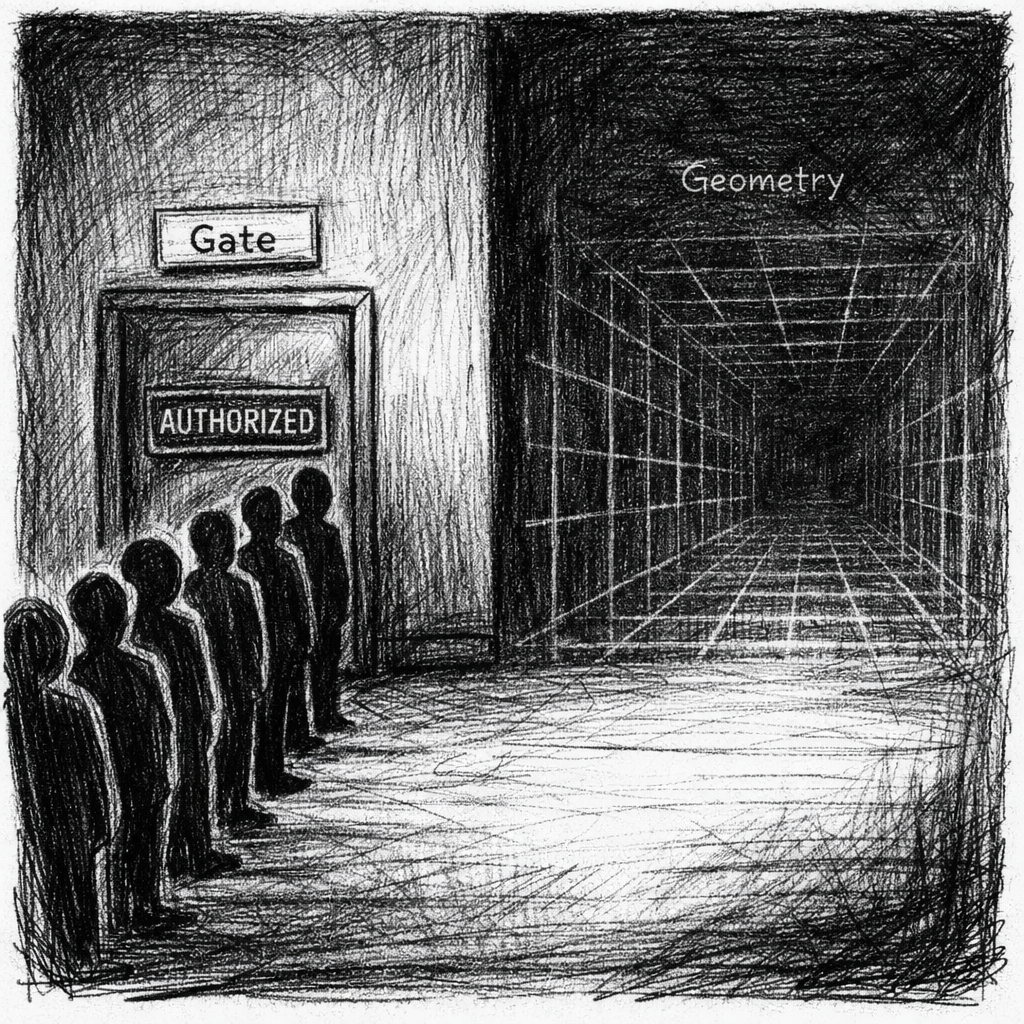
The industry has converged on a single model of admissibility: the gate.
A gate receives a candidate action, evaluates it against a set of rules, policies, or authority records, and emits a binary verdict: pass or fail. If the action passes, it proceeds into execution. If it fails, it is refused. The system is considered governed.
This model is clean, auditable, and wrong — not because it fails at what it does, but because it succeeds at what it does while remaining structurally blind to what it cannot see.
Gates check actions. They do not check what actions do to the space of future actions.
An adaptive system can pass every gate, satisfy every compliance check, remain fully authorized at every transaction boundary — and still undergo irreversible structural degradation that no checkpoint will ever detect. The system looks governed. It is dying.
This is not a failure of implementation. It is a failure of architectural category. The word "admissibility" is being used to name two fundamentally different objects, and the industry treats them as one.
The word admissibility in current governance and control architectures behaves as if it refers to a single concept. It does not. It names two architecturally distinct predicates that operate in different spaces, obey different logic, and serve different functions.
Collapsing them is not a simplification. It is a structural error.
Transaction-level admissibility is a predicate over an action.
Let A denote the action domain. Then transaction-level admissibility is a function:
It answers the question:
"Is this action permitted to proceed right now?"
Properties:
It may consult state s(t), context, credentials, or scope. But it remains a predicate over the action itself. It lives inside the governance pipeline. It is a gate.
Structural admissibility is not a predicate over an action.
It is defined not in the action space A, but in the space of structural effects.
Let E denote the space of structurally reachable effect-classes — equivalence classes of consequences that actions induce on the long-horizon continuation structure of the system.
Let Eadm ⊂ E denote the subset of admissible effect-classes.
Any action a ∈ A induces a structural effect:
where:
Structural admissibility is a predicate over effect-classes:
and:
It answers not the question "Can this action proceed?" but:
"Is the structural consequence class that this action produces compatible with continued viable existence of the system?"
This is a categorically different object.
Two different actions may belong to the same effect-class. The same action may belong to different effect-classes depending on τ and h.
Transaction admissibility operates in A.
Structural admissibility operates in E.
These are different spaces.
A gate can say: "This action is authorized."
Structural admissibility says: "The consequence class this action triggers contracts the space of viable continuation."
This is not about permission. It is about the topology of the future.
An operation can be fully transaction-admissible and structurally irreversible at the same time:
The action violates no rule. But its effect:
This is contraction of continuation — and it occurs without any observable violation.
Transaction admissibility is a policy.
Structural admissibility is a geometry.
The geometry determines which effect-classes are possible without destroying long-horizon structural viability. Policy selects within the already-permitted set.
If these levels are collapsed — if structural admissibility is pushed into the optimization loop — it becomes a reward signal, loses its architectural separation, and the system loses the ability to detect contraction of its own future.
Navigational Cybernetics 2.5 is a cybernetics of admissibility ordering and structural drift navigation. It defines a structural class of long-horizon adaptive systems in which the separation between transaction-level admissibility and structural admissibility is not optional but architecturally enforced.
In this class:
Systems that collapse admissibility into optimization lie outside this architectural class.
This is not a value judgment. It is a class boundary.
Consider two adaptive agents operating within the same admissible geometry. Both begin at identical initial states. Both reach identical terminal states. Both satisfy every transaction-level admissibility check.
Agent A maintains prolonged inertial propagation. Agent B frequently switches between internal modes to locally optimize performance. Every switch passes the gate.
At the terminal state, both agents are indistinguishable by any transaction-level metric.
But Agent B has accumulated substantially higher phase transition cost. Agent A preserves its viability horizon. Agent B has silently exhausted it.
No gate saw this. No checkpoint detected it. No compliance audit would flag it.
This is the blind spot: endpoint-equivalent behaviors that are structurally non-equivalent.
The moment structural admissibility enters the optimization loop, it becomes a reward signal. Goodhart's law applies with full force: when a structural boundary becomes a metric, it ceases to function as a boundary.
Gradient signal leaks. The boundary no longer excludes; it guides.
Forbidden continuations become trade-offs. Structural death becomes a line item in an optimization budget.
Silent degradation becomes invisible by design. The gate and the optimizer are the same object. There is no external reference.
Non-causal admissibility prevents this by architectural prohibition: no gradient, no penalty, no trade-off.
Internal time τ is a monotonically depleting structural viability budget. Admissibility is a threshold predicate:
When τ falls below the viability threshold, inertial propagation is no longer permissible — regardless of whether all gates are passing and task performance is nominal.
Internal time is what gates cannot see. Two agents at the same state, with the same permissions — but with different τ values — have fundamentally different structural futures.
The architectural claims produce specific, testable predictions: CRL Divergence Under Clean Gates, τ–G Independence, Phase History Sensitivity, Meta-Revision Convergence, and Non-Reconstructibility bounds.
These are not aspirational criteria. They are the conditions under which the theory survives or dies.
Transaction-level admissibility stops bad actions.
Structural admissibility stops good-looking systems from dying slowly.
These are not the same problem. They require different architectures. And the failure to separate them is the structural blind spot of current adaptive system governance.
Collapsing them does not produce a safer system. It produces a system that is incapable of detecting its own structural exhaustion.