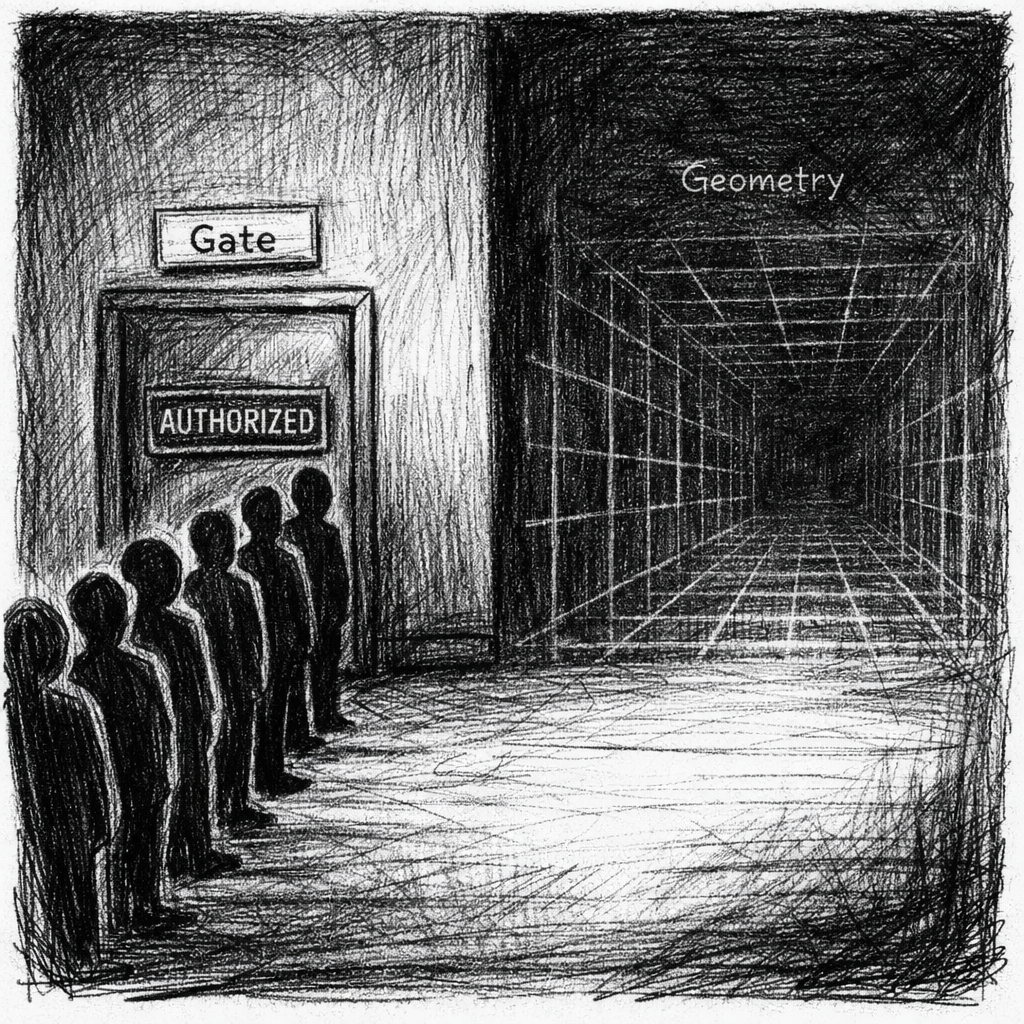
Transaction-Level Admissibility Stops Bad Actions. Structural Admissibility Stops Good-Looking Systems From Dying Slowly.
MxBv
PETRONUS Architectural Theory · NC2.5 Series
CC BY-NC-ND 4.0
1. The Gate Illusion
The industry has converged on a single model of admissibility: the gate.
A gate receives a candidate action, evaluates it against a set of rules, policies, or authority records, and emits a binary verdict: pass or fail. If the action passes, it proceeds into execution. If it fails, it is refused. The system is considered governed.
This model is clean, auditable, and wrong — not because it fails at what it does, but because it succeeds at what it does while remaining structurally blind to what it cannot see.
Gates check actions. They do not check what actions do to the space of future actions.
An adaptive system can pass every gate, satisfy every compliance check, remain fully authorized at every transaction boundary — and still undergo irreversible structural degradation that no checkpoint will ever detect. The system looks governed. It is dying.
This is not a failure of implementation. It is a failure of architectural category. The word "admissibility" is being used to name two fundamentally different objects, and the industry treats them as one.
2. Two Objects, One Word
The word admissibility in current governance and control architectures behaves as if it refers to a single concept. It does not. It names two architecturally distinct predicates that operate in different spaces, obey different logic, and serve different functions.
Collapsing them is not a simplification. It is a structural error.
2.1 Transaction-Level Admissibility
Transaction-level admissibility is a predicate over an action.
Let A denote the action domain. Then transaction-level admissibility is a function:
Admₜ : A → {0, 1}
It answers the question:
"Is this action permitted to proceed right now?"
Properties:
- Binary (pass/fail).
- Local: evaluated at the moment of the transaction.
- Stateless with respect to structural history.
- Embedded in the causal enforcement loop: it participates directly in the decision flow.
- Typically realized as a constraint, policy rule, compliance check, safety filter, or authority gate.
2.2 Structural Admissibility
Structural admissibility is not a predicate over an action.
It is defined not in the action space A, but in the space of structural effects.
Let E denote the space of structurally reachable effect-classes — equivalence classes of consequences that actions induce on the long-horizon continuation structure of the system.
Let E_adm ⊂ E denote the subset of admissible effect-classes.
Any action a ∈ A induces a structural effect:
e = e(s, a, τ, h) ∈ E
where:
- s — current system state,
- τ — internal time (remaining structural viability budget),
- h — accumulated phase history.
Admₛ : E → {0, 1}
and:
E_adm = { e ∈ E | Admₛ(e) = 1 }
It answers not the question "Can this action proceed?" but:
"Is the structural consequence class that this action produces compatible with continued viable existence of the system?"
This is a categorically different object.
2.3 Action vs Effect-Class
Two different actions may belong to the same effect-class. The same action may belong to different effect-classes depending on τ and h.
Transaction admissibility operates in A.
Structural admissibility operates in E.
These are different spaces.
A gate can say: "This action is authorized."
Structural admissibility says: "The consequence class this action triggers contracts the space of viable continuation."
This is not about permission. It is about the topology of the future.
2.4 Irreversibility Without Violation
An operation can be fully transaction-admissible and structurally irreversible at the same time:
Admₜ(a) = 1 but e(s, a, τ, h) ∉ E_adm^(long-horizon)
The action violates no rule. But its effect:
- Contracts the set of future admissible effect-classes.
- Increases structural burden.
- Reduces the horizon of viable continuation.
2.5 Geometry Before Policy
Transaction admissibility is a policy.
Structural admissibility is a geometry.
The geometry determines which effect-classes are possible without destroying long-horizon structural viability. Policy selects within the already-permitted set.
If these levels are collapsed — if structural admissibility is pushed into the optimization loop — it becomes a reward signal, loses its architectural separation, and the system loses the ability to detect contraction of its own future.
3. The Architectural Class
Navigational Cybernetics 2.5 is a cybernetics of admissibility ordering and structural drift navigation. It defines a structural class of long-horizon adaptive systems in which the separation between transaction-level admissibility and structural admissibility is not optional but architecturally enforced.
In this class:
- Authorization is architecturally prior to optimization. No action enters evaluation, ranking, or execution before its structural admissibility has been resolved.
- Irreversible operations are gated before they are evaluated. The structural gate is not downstream of the decision loop — it is upstream of it.
- Drift is not treated as error, noise, or deviation to be minimized. It is an irreducible structural medium of evolution under sustained interaction. Every adaptive system that operates long enough accumulates drift. The question is not how to eliminate it but how to navigate within it.
- Viability is preserved not by reward shaping, constraint penalties, or corrective feedback, but by non-causal regulation of admissible continuation and regime transitions.
- Admissibility-relevant structure may be visible, but it is categorically prohibited from becoming causally actionable within the decision loop. The system may observe the boundary of structural admissibility, but it cannot optimize against it, penalize departure from it, or use it as gradient signal. This is the non-causal constraint.
This is not a value judgment. It is a class boundary.
4. Why Gates Are Necessary But Blind
Consider two adaptive agents operating within the same admissible geometry under the same constraints. Both begin at identical initial states. Both reach identical terminal states. Both satisfy every transaction-level admissibility check along the way.
Agent A maintains prolonged inertial propagation — it stays within a single operational regime, minimizing internal reconfiguration.
Agent B frequently switches between internal modes to locally optimize performance. Every switch passes the gate. Every action is authorized. Every checkpoint is clean.
At the terminal state, both agents are indistinguishable by any transaction-level metric.
But Agent B has accumulated substantially higher phase transition cost. Each internal mode switch — each reconfiguration of control structure, estimation loop, or policy selection — incurred an irreversible structural load. Not because the switches were unauthorized, but because internal reconfiguration is not free. It consumes structural degrees of freedom. It depletes internal time.
Agent A preserves its viability horizon. Agent B has silently exhausted it.
No gate saw this. No checkpoint detected it. No compliance audit would flag it.
This is the blind spot: endpoint-equivalent behaviors that are structurally non-equivalent.
The gate sees the action. It does not see the phase history. It does not see the accumulated cost of getting to the same place by different structural paths. It does not see that one path preserves continuation and the other contracts it to zero.
Phase transition cost is not trajectory energy. It is not control effort. It is not instantaneous error. It is irreversible structural consumption associated with internal reconfiguration — and it accumulates independently of everything that gates measure.
5. What Happens When You Collapse Them
The temptation is natural: if structural admissibility matters, include it in the objective function. Make the system optimize for it. Penalize contraction. Reward preservation.
This is precisely the move that destroys the architecture.
The moment structural admissibility enters the optimization loop, it becomes a reward signal. The system begins to optimize against it. And the moment it optimizes against it, admissibility is no longer a boundary — it is a target.
Goodhart's law applies with full force: when a structural boundary becomes a metric, it ceases to function as a boundary.
But the damage is deeper than Goodhart. When admissibility collapses into the causal loop:
Gradient signal leaks. The system learns to predict which actions approach the admissibility boundary and adjusts behavior accordingly. This is not governance — it is reward shaping with extra steps. The boundary no longer excludes; it guides.
Forbidden continuations become trade-offs. What was previously architecturally impossible becomes merely expensive. The system can now "choose" to cross the boundary if the expected return justifies the penalty. Structural death becomes a line item in an optimization budget.
Silent degradation becomes invisible by design. If the optimization loop is the only place where admissibility is evaluated, and the optimization loop has learned to navigate around it, the system has no independent mechanism for detecting structural contraction. The gate and the optimizer are the same object. There is no external reference.
The result is a system that appears governed — every decision passes through an admissibility-shaped objective — while the actual structural boundary has been dissolved into the reward landscape.
Non-causal admissibility prevents this by architectural prohibition: the boundary exists, the system may observe it, but it cannot act on it. No gradient. No penalty. No trade-off. The exclusion predicate is upstream of the decision loop and does not participate in it.
This is not a restriction on the system's intelligence. It is a restriction on where intelligence is permitted to operate.
6. Internal Time and the Horizon of Continuation
The mechanism through which structural admissibility operates is internal time.
Internal time τ is not clock time. It is not step count. It is a monotonically depleting structural viability budget induced by irreversible burden accumulation over operational history. The burden is monotone: it increases and does not recover. Accordingly, remaining internal time decreases and does not recover.
Admissibility is a threshold predicate on τ:
Admₛ = 𝟙[τₜ > τ_min]
When τ falls below the viability threshold, inertial propagation is no longer permissible. The system must revalidate, restructure, or terminate — regardless of whether instantaneous error is zero, all gates are passing, and task performance is nominal.
This is the architectural mechanism that makes structural admissibility non-causal: τ is consumed by operations, but the threshold predicate does not feed back into the dynamics of τ itself. It does not shape behavior. It does not provide gradient. It marks an exclusion boundary and nothing more.
Internal time is what gates cannot see. Two agents at the same state, with the same permissions, passing the same checks — but with different τ values — have fundamentally different structural futures. One can continue. The other cannot.
7. Empirical Surface
A theory that cannot be falsified is not a theory. The architectural claims made here produce specific, testable predictions:
CRL Divergence Under Clean Gates. If two implementations within the declared architectural class exhibit identical transaction-level admissibility records but different phase histories, their Coherent Run-Length (CRL) — the duration of structurally coherent operation before identity discontinuity — must diverge. If CRL does not diverge under differing phase histories with identical gate records, the theory is refuted.
τ–G Independence. Internal time τ must be statistically independent of the gate function G (transaction-level admissibility). If τ and G are correlated — if knowing the gate state allows prediction of internal time — then the non-causal separation has been violated and the architecture collapses into transaction-level governance. This is directly testable via mutual information estimation.
Phase History Sensitivity. Endpoint-equivalent behaviors with different phase transition densities must exhibit measurably different τ depletion rates. If two paths through the same start and end states, both fully gate-admissible, show identical τ trajectories regardless of switching frequency, the phase transition cost mechanism is empirically empty.
Meta-Revision Convergence. If the system includes a meta-revision layer (structural revalidation), it must converge in finite steps under Lyapunov descent. Indefinite meta-revision chatter — oscillation without convergence — falsifies the bounded revision claim.
Non-Reconstructibility. The admissibility boundary must satisfy non-reconstructibility bounds: an observer with access only to the causal decision stream cannot reconstruct the structural admissibility predicate beyond ε accuracy as specified by the NR-ε condition. Violation of this bound — demonstrated via mutual information accumulation, side-channel analysis, or bounded log-likelihood ratio tests — constitutes formal leakage of structural admissibility into the causal loop.
These are not aspirational criteria. They are the conditions under which the theory survives or dies.
8. Conclusion: The Depth Distinction
The industry builds gates because gates are auditable, implementable, and legible. This is correct. Transaction-level admissibility is necessary infrastructure.
But it is not sufficient architecture.
Structural admissibility operates at a different level — not within the enforcement flow, but prior to it. Not as a policy decision, but as a geometric constraint on what can be proposed at all. Not as a causal participant in the decision loop, but as a non-causal exclusion predicate that shapes the space of possibility without entering the space of action.
The distinction is architectural, not terminological. Systems that maintain it can detect silent degradation, regulate phase transition cost, and preserve viability over horizons that no checkpoint covers. Systems that collapse it — that push structural admissibility into the optimization loop — lose the only mechanism capable of seeing what gates cannot see.
Transaction-level admissibility stops bad actions.
Structural admissibility stops good-looking systems from dying slowly.
These are not the same problem. They require different architectures. And the failure to separate them is the structural blind spot of current adaptive system governance.
Collapsing them does not produce a safer system. It produces a system that is incapable of detecting its own structural exhaustion.
This work is part of the Navigational Cybernetics 2.5 architectural theory.
Patent applications related to structural admissibility, internal time regulation, phase transition cost, and identity continuity detection are filed with the USPTO.
Contact: research@petronus.eu
Site: petronus.eu
Originally published at petronus.eu on 2026-02-28.
Republished under CC BY-NC-ND 4.0.
Canonical: https://petronus.eu/publications/transaction-vs-structural-admissibility
Do not reproduce without attribution. No derivatives permitted.