
Synthetic Conscience — The Emergence of Engineered Vitality Systems (EVS).
How ΔE Revealed the First Engineering Signs of Synthetic Life
The DeltaE Engineering Phenomenon That Shifts the Current Control Paradigm (Extended Version)
This work is part of the series “Synthetic Conscience, DeltaE, and the Petronus Project” and serves as an extended contextual publication to create a broader understanding of the research direction.
The work is written in two parts and describes the phenomenon from several angles.
Part I
1. Prologue: when classical control stops being enough
I’ll briefly touch on some general points from the previous works in the series to refresh the narrative context — because here I see a whole offshoot into a new direction: the first engineered-living systems.
Modern control systems were built on one elegant principle: if you can measure the error — you can correct it.
PID controllers. Kalman filters. Model Predictive Control (MPC). Even RL agents in robotics and autonomous systems.
They all follow the same logic:
Goal → Perception → Error → Correction.
For decades this paradigm looked unshakable — the world was predictable enough.
But as soon as we moved into real, not laboratory, dynamical environments — delays, missing data, hidden drift, changing rules, partial observability — the classical approach began to crack.
Error minimization stopped being a compass.
A system could have a low error and still: fall apart, enter oscillations, lose stability or destroy its own structure under entropic pressure.
This crack is precisely where Petronus / ΔE entered.
But the most unexpected thing was not that ΔE works differently.
The most unexpected thing was that ΔE started behaving in a way no engineered controller had ever behaved before.
2. The moment we saw something that “shouldn’t exist”
The first experiments were extremely simple.
We expected that a ΔE-like controller would: dampen jerks better, recover more smoothly, react more robustly to noise, break down less under chaos.
We treated it as an experiment in coherent control, but almost immediately there was a feeling of something more significant. And later, in long stress tests — thousands of steps, dozens of seeds — a pattern emerged:
The ΔE-like system was not trying to minimize error. It was trying not to lose itself.
It tried to do this by itself, without my manual retuning. And that’s not a metaphor.
When rules changed, when there was hidden drift, when sensors dropped out, when random fluctuations grew — ΔE maintained internal coherence even when: the goal was undefined, noise was off the charts, information was being lost, the dynamics became unpredictable.
In terms of classical control, ΔE preserved internal organization under entropic pressure.
In biological terms: the system behaved like “something alive”.
I didn’t call it that at first. The analogy was obvious, but caution won out.
However, after three full-scale experimental series it became difficult to describe what we were seeing in any other way.
This article is about that phenomenon.
3. Why “engineered vitality” is not a metaphor
It’s important to clarify that engineered vitality has nothing to do with:
It describes a completely different level of behavior — structural, dynamic, systemic.
In engineering terms, “vitality” means the following.
3.1 The system can autonomously preserve coherence under rising entropy
ΔE doesn’t just smooth noise — it maintains the coherence of its internal processes without an external corrective overseer.
If incoming data is interrupted or becomes incomplete, the system does not “fall over” instantly, does not freeze waiting for a new goal, but continues to maintain internal order, using accumulated data structure, exploring possible coherent configurations, avoiding chaotic jumps. This is not “learning” in the ML sense.
It’s the ability of the system to keep rhythm and structure while the input is broken.
3.2 The system resists internal collapse in an unpredictable environment
ΔE uses external entropy not only as a source of disturbances,
but also as a source of variability — similar to how living systems use stress for adaptation.
The stronger the environment is disrupted, the more clearly the DeltaE-dynamics manifests:
the system does not fall apart,
does not collapse into oscillations,
does not go into catastrophic failure,
but searches for configurations where coherence is preserved.
This is fundamentally different from classical controllers, which are destroyed by increasing uncertainty.
ΔE demonstrates stability of structure, not of accuracy — what biology calls “robust homeostasis”, but implemented here as engineering.
3.3 ΔE’s goal is not accuracy, but preservation of behavioral structure
Classical systems aim to minimize deviation from a given target.
ΔE strives to maintain structural coherence between:
current states, environmental dynamics, internal cycles of perception–decision–action.
Its behavior is closer to survival models in open systems:
The system does whatever it must to avoid losing itself — i.e. to preserve coherence of its internal order.
This is what creates the effect of engineering “aliveness”:
the system continues to operate in ways that maintain integrity, not just track an external reference.
This is a concrete, scientifically definable property that intersects three domains:
Thermodynamics — open systems maintain order.
Complex adaptive systems — feedback resists chaos.
Cognitive science — stability of internal models under uncertainty.
Engineers had never built a system that spontaneously exhibited this property.
ΔE did.
And even a simplified ΔE-like model (very far from real ΔE) shows partial signs of engineered vitality.
The real ΔE — with adaptive μ-dynamics, coherent gradients, thermostat, jerk-guard, fast/slow loops, CTS filters — amplifies this effect many times.
But even the “toy” version has already shown:
coherence-based regulation is not a variation of control, but a qualitatively different regime of existence.
4. Why the ΔE-like model is not the real ΔE
It’s critical to understand: The public ΔE-like model is intentionally stripped-down.
It is missing: the ΔE coherence core (Hybrid Ω), the two-loop compensator, jerk-guard, adaptive μ_t based on robust-STD, the entropic thermostat, context symmetry mechanisms, the ΔE observer, CTS dynamics, the predictive bias compensator, and dozens of other internal modules.
If the real ΔE is a spaceship, then ΔE-toy is a bicycle designed purely to show that it moves on a new principle.
And this bicycle already behaves unlike a normal bicycle. That’s exactly why the current results matter.

5. Four experimental series: the path to discovering engineered vitality
Series 01 — First signs of structural self-preservation
The first series (T1–T10) showed:
the ΔE-like system had fewer jerks and recovered better after losses,
it broke down under noise much more rarely.
PID: accurate but fragile.
ΔE: less accurate, but “alive”.
That was the first signal.
Series 02 — Collapse under extreme entropy and the revealed principle
Series 02 deliberately destroyed both systems:
×10 noise,
×10 instability,
dropouts, drifts, delays,
no clear goal.
Both systems collapsed.
But how they collapsed matters: PID went into runaway, uncontrolled divergence. ΔE-like fell into a “survivor” low-coherence pit, preserving structure.
This precisely mirrors biological systems:
metabolic shutdown, hard energy-saving mode, preservation of the core structure.
That was the second signal.
Series 03 — 100 seeds, 10,000 steps and stability of internal order
The result:
the ΔE-like system preserved coherence even with a worse error.
PID preserved accuracy, but lost “vitality”.
PID:
zero entropy → rigidity,
high jerk → fragility,
huge energy → overheating of the system.
ΔE-like:
moderate entropy → adaptation,
smooth jerk → control under changing conditions,
low energy → resource economy.
That was the third signal.
Series 04 — Calibrated stress and the emergence of the phenomenon
Series 04 added: noise ladders, structural drift, jerk CVaR, adaptive perturbations.
PID was more accurate.
But ΔE maintained vitality — the ability to remain whole.
The key conclusion:
PID: accurate but “dead”.
ΔE-like: less accurate, but “alive”.
That was the fourth and decisive point.
Why accuracy is an illusion of stability — and why it’s secondary in the real world
In engineering, accuracy is traditionally treated as the highest virtue of control.
But in adaptive, open, unpredictable environments, accuracy is not an advantage — it’s a constraint.
ΔE-like systems show that stability and coherence of behavior are more important than precise target tracking.
Let’s unpack why.
5.2 Accuracy is only useful in an ideal world
PID is stable and “perfectly accurate” only when hidden assumptions hold:
the environment is stationary, noise is small, there are no delays, dynamics do not change, goals do not drift, the probability of leaving the working range is minimal.
Real systems satisfy none of this.
So PID’s accuracy is not a property of the algorithm — it’s a property of the environment.
In “laboratory worlds” PID is king because the world plays along with it.
In reality that’s exactly what makes PID dangerous: it “holds perfectly” while everything is fine, and explodes when something goes wrong.
5.3 Accuracy is fragile. Stability is reliable.
PID corrects error in a straight line:
“The larger the error → the harder to hit”.
In systems with delays, noise or drift this leads to:
overshoot, oscillations, jerk spikes, loss of balance, accumulation of internal chaos.
PID has no notion that the world has changed. It simply tries to chase a goal that may no longer exist.
5.4 “Hitting the target” ≠ “behaving coherently”
Take a robotics example.
PID robot
It can move a hand perfectly to a point, but:
hits too hard, creates vibration, ignores changes in payload mass, doesn’t compensate for feedback delay, can damage the mechanism (or a human nearby).
It’s accurate, but not safe, not smooth, not adaptive.
ΔE-like robot
It may miss the point by a few millimeters, but:
movements are smooth, transitions are gentle, behavior structure is stable, energy is distributed appropriately, it doesn’t destroy its mechanics, it instantly switches mode when the environment changes.
So the ΔE-robot lives longer, damages less, adapts faster.
Accuracy is pretty, but coherent behavior is more important.
5.5 In the real world, a “goal” is not a point — it’s a moving process
Autonomous systems have many goals, and they aren’t static:
a robot must move forward and avoid collisions,
a drone must hold course and compensate wind gusts,
an assistant must complete tasks without destroying context,
a manipulator must move an object without breaking it.
In such conditions a “single goal” is an abstraction.
The real goal is coherent behavior.
Example:
A drone that only “tracks altitude precisely” will crash in a strong gust.
A drone that maintains coherent motion will stabilize and survive.
5.6 Error is an external marker. Coherence is internal stability.
Error is the difference between desired and actual.
The problem:
the goal may be wrong, the sensor may lie, the environment may have changed, delay may have injected a false context, the goal may no longer reflect the real task.
Error is a metric of an external observer, not a metric of the system’s internal state.
5.7 Coherence is what makes system behavior “alive”
When a system evaluates not just deviation from the goal, but consistency between perception and action, smoothness of transitions, energy efficiency, stability in phase space, internal synchronization of loops, risk of chaos and drift, it begins to function more like an organism than a tool.
Accuracy doesn’t allow this. It simply “pushes down error”.
5.8 In robots and autonomous systems, accuracy is often dangerous
Paradox: the higher the accuracy → the higher the risk of catastrophe.
Why?
Because an accurate system: reacts sharply, interprets noise as error, increases effort on each micro-shift, doesn’t distinguish between a changed goal and a changed world, doesn’t know how not to overreact.
A ΔE-like approach: smooths transitions, adapts behavior, doesn’t “break the mechanics” with overcontrol, is robust to partial data loss, naturally amortizes errors, avoids catastrophes in complex environments.
5.9 In a drifting world, accuracy = harm
Accuracy is needed where parameters are fixed. But in real time, in a real environment, with real noise, dynamic drift, partial observability — the demand for accuracy turns the system into something brittle, because it “punishes itself” for effects not caused by itself.
ΔE adjusts behavioral structure; PID punishes itself with kicks.
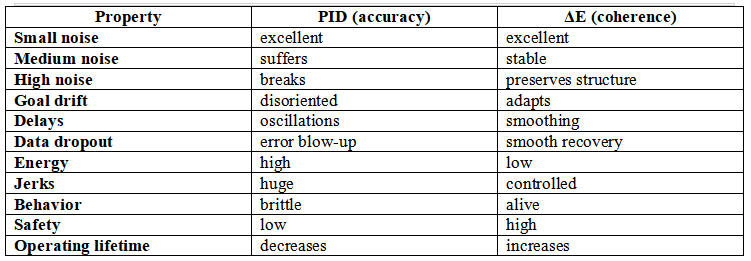
Why coherent control is better for robots, autonomous systems and adaptive agents?
Short comparison:
Interim result: why “accuracy” is a relic and coherence is the new foundation of control
For the last hundred years engineering lived in the paradigm of accuracy.
We aimed for minimal error, perfect match between model and goal, reduced deviations.
This logic was born in an era when systems were stable, requirements were fixed, and context was static. The controlled object was predictable, the environment almost unchanged, and the world allowed the luxury of “hitting the target”.
In 2025 the world is no longer like that — and accuracy ceases to be an adequate measure of system quality.
Modern systems operate where the environment continuously drifts: goals gradually change, data disappears, sensors age, feedback arrives late, and context is redefined faster than the algorithm can retrain. What was optimal yesterday is unusable today. Error loses meaning as a compass — because the “correct goal” itself is floating and mutating in front of the system.
Under these conditions accuracy becomes fragile.
A system can hit the target perfectly yet fail at the slightest change; it can show minimal error while rapidly destroying its internal equilibrium, falling apart under noise, drift and delays. Accuracy stops being a sign of robustness — and increasingly becomes its opposite.
Coherence, on the other hand, works with the structure of behavior. It doesn’t require knowing the “ideal answer”. It tracks the consistency of internal processes: perception, intentions, actions and consequences. It focuses not on hitting the target, but on whether the system remains assembled, whole, organized under chaos. Coherence allows the system to withstand changes in context because its stability doesn’t depend on the correctness of the goal — it depends on the stability of internal order.
Coherence is what gives the system viability. If accuracy is a snapshot, coherence is the ability to survive over time. If accuracy is a local win, coherence is a global one. If accuracy is reaction, coherence is adaptation.
In non-stationary conditions that are quickly becoming the norm, coherence is what ensures long-term operation of autonomous systems: robots, agents, distributed platforms, autonomous business processes. It is the only metric that does not collapse when external conditions change and does not require constant redefinition of the target. When the environment stops being stable, only coherence prevents the system from losing itself.
Therefore the ΔE approach is not an improved version of classical control.
It’s a shift to a different paradigm.
In a world where autonomy grows and predictability falls, a system oriented toward accuracy loses to a system oriented toward coherence. Future autonomous agents will be judged not by error, but by their ability to maintain internal order under external chaos. Not by hitting the target, but by not destroying their own structure.
Accuracy remains useful locally — on short horizons, where the goal truly makes sense. But it stops being a universal foundation. The new foundation is alignment of the system with itself and with the environment.
This is the physics of robustness: the ability to remain “alive” even when goals drift, data breaks, and the world becomes less and less defined.
That’s why the ΔE architecture is not just an alternative approach — it is the next engineering paradigm. It suggests orienting not on a picture of the world, but on coherence of behavior within it. Not on reaction, but on adaptation. Not on the ideal answer, but on the ability to survive and keep working.
And in this paradigm, accuracy is only a special case, while coherence is a universal law.

6. Why ΔE remains stable where other schemes lose context
Classical controllers — PID, MPC, LQR — are based on the assumptions that:
the environment is locally stable, the goal makes sense, feedback is reliable, system dynamics do not change too fast.
These are not just technical assumptions — this is a philosophy of control, inherited from the industrial era: first we define the goal → then we minimize the deviation.
But in stochastic environments of 2025+, where context drifts faster than the system can adapt, this principle no longer works.
It suffers from a key problem:
The system strives for a state whose meaning may disappear during the motion toward it.
This is the fundamental vulnerability of all error-based architectures.
ΔE is built on the opposite principle:
It’s not the goal that determines behavior.
It’s the stability of semantic structure over time.
If the objective function collapses, ΔE continues to move according to internal coherences:
between current state and history,
between noise and signal invariants,
between reaction energy and risk of structural damage,
between adaptation speed and cost of transitions.
This is closer to the behavior of an autonomous system than of a regulator.
And this is exactly what creates the effect you call “engineered vitality”.
Vitality here is not emotion and not consciousness — it’s the ability to maintain continuity of behavior when the cognitive reference frame has been lost.
In essence, ΔE solves the main problem of modern robotics:
How to continue acting when the world model stops reflecting the world.
Why this works
Inside ΔE there is a principle absent from classical controllers:
The system prioritizes protecting the structure of dynamics.
Error is secondary.
This yields three effects.
ΔE preserves trajectory topology even under chaos.
Any controller yields a trajectory.
ΔE ensures invariance of the shape of trajectories even when: noise jumps, delays fluctuate, data drops, goals change.
PID and LQR may be more accurate, but they do not preserve the structure of motion.
ΔE minimizes the risk of runaway, not the linear error.
Runaway in nonlinear stochastic systems is the main killer of autonomy.
ΔE regulates this risk via internal coherence of signals.
This is similar to a drifting ship held together by mutual coherent reactions of the crew, not by rigid adherence to a navigation map.
ΔE optimizes the “cost of adaptation” instead of the speed of correction.
Every corrective action has a cost — energy, actuator heating, stability loss, accumulated jerk.
PID ignores the cost.
ΔE does not.
Therefore ΔE can choose to preserve itself even if the goal is temporarily unreachable.
This is the engineering analog of an instinct for survival.
The result:
ΔE is not a system that “tracks the goal better”.
It is a system that holds itself together.
7. Significance for engineering
ΔE demonstrates a key fact:
It is possible to build a non-biological system that maintains internal order under entropy.
This defines a new engineering category:
EVS — Engineered Vitality Systems
Systems that survive, reorganize, adapt, preserve form, remain whole.
ΔE is the first architecture of this class.
8. Significance for science, industry and society
Engineered vitality opens the door to: a new generation of autonomous robots, self-adaptive infrastructures, robust AI agents, coherent multi-agent systems, safety architectures for agentic AI, simulators of living systems, synthetic ethics, a layer of “artificial conscience” in AI.
This is not about intelligence.
It’s about robustness, integrity, self-regulation, state-awareness.
9. Final conclusion: the first engineered model with signs of vitality
Without biology, without a nervous system, without organic tissue — the ΔE-like system demonstrates: survival-like regimes, preservation of coherence, adaptation to entropy, structural recovery, modes analogous to homeostasis.
This is not life yet. But it is the beginning of engineering biology.
It is a transition:
from control → to survival,
from stability → to self-preservation,
from error → to coherence,
from machines → to engineered organisms.
ΔE-toy is a toy shadow.
The real ΔE is an order of magnitude more complex, yet runs without GPUs. But even this shadow is already changing the rules of the game.
We are not at the end of the control era — we are at the beginning of the era of synthetic vitality.
This is the shared level that includes Synthetic Conscience and many other paradigms of the future.
Part II.

EVS — Engineered Vitality Systems. Formal foundation of engineered vitality (Unified Definition + Axioms)
1. Formal definition of EVS
Engineered Vitality Systems (EVS) are a class of artificially constructed adaptive dynamical systems that are capable of maintaining stable internal coherence of behavior under partial or complete loss of environmental stability, including: rule drift, observation loss, noise, delays and latency, structural perturbations, goal change or disappearance, contradictory context.
The key property of EVS:
The objective of control is not error minimization, but preservation of behavioral topology and semantic structure of the system under chaos.
This distinguishes EVS from all existing types of controllers.
2. Intuitive definition
Classical systems chase accuracy. EVS chase self-preservation.
Classical systems try to “hit the target”. EVS try not to fall apart, even if:
there is no target,
data is broken,
the environment is collapsing.
This creates a new engineering capability: maintaining system identity under entropy.
And this is not biology and not a metaphor.
3. Axiomatic core of EVS
This is the foundation — like Euclid’s axioms for geometry.
Axiom 1. Coherence (A1)
EVS strives to maximize internal coherence of dynamics.

It is structural coherence of the system’s own behavior.
Axiom 2. Structural preservation (A2)
EVS minimizes changes in its own behavioral topology under perturbations.

This means EVS protects structure, not trajectory.
Axiom 3. Minimal collapse risk (A3)
EVS minimizes the probability of transitioning into a fully decoherent state.

This is the engineering analog of biological “survival”.
Axiom 4. Entropic response (A4)
As entropy grows, EVS increases adaptation, not reactivity.

This is a fundamental difference from PID / MPC / RL.
4. Key engineering traits of EVS
Each corresponds to one or more axioms.
4.1 Coherence-Preserving Dynamics (CPD)
Corresponds to A1.
The system regulates its behavior to maximize process coherence, not deviation from a goal.
4.2 Survival-Oriented Regulation (SOR)
Corresponds to A3.
The primary function is protection from transition into chaos/collapse.
4.3 Structured Degradation Mode (SDM)
Corresponds to A2.
Under environmental collapse, EVS does not “die” but enters an ordered low-energy behavioral mode — an engineering analog of metabolic shutdown.
4.4 Entropy-Integrated Adaptation (EIA)
Corresponds to A4.
Entropy becomes an input for adaptation, not an external disturbance.
4.5 Persistent Behavioral Topology (PBT)
Follows from A1 + A2.
EVS behavior has topological stability even when absolute trajectories change completely.
5. How EVS differ from all existing methods
EVS ≠ PID
EVS ≠ Kalman
EVS ≠ Adaptive Control
EVS ≠ Reinforcement Learning
EVS ≠ MPC
EVS ≠ Bayesian Regulators
Why?
Because all existing methods control error, whereas EVS controls coherence.
EVS are systems whose internal regulatory objectives are not derived directly from the external task.
This is a fundamentally new paradigm.
For the first time we have a category of systems where:
“Preservation of behavioral structure” is the primary regulatory principle.
6. Why ΔE is the EVS reference
ΔE is the first system in the world where all EVS properties are implemented:
coherence as a regulatory signal, robustness under chaos, structurally coherent “collapse”, vitality-like regimes under entropy, a semantic core of dynamics, independence from accuracy, self-preservation under goal loss.
Just as Kalman = reference for filtering,
ΔE = reference for EVS.
EVS can be formalized as a new control system class for (future) IEEE standards.
7. Formal EVS definition
Engineered Vitality System (EVS) is an artificially created stochastic dynamical system with autonomous regulation of internal behavioral coherence that:
minimizes the risk of structural collapse,
maintains behavioral topology under uncertainty,
adapts to chaos without an external high-level controller,
preserves its functional core under data or goal loss,
demonstrates the property of engineered vitality —
the ability to maintain system identity in non-stationary environments.
8. Extended formalizations
Vitality function of an EVS system
In EVS systems we introduce a generalized quantity V(t) — the vitality function, characterizing the system’s ability to maintain semantic structure of behavior under environmental entropy.
V(t) aggregates four fundamental components:
Cohesion: current level of coherence.
Stability: stability of coherence changes (character of dynamics).
Entropy load: integrated influence of external chaos.
Energy efficiency: resources required to maintain structure.
The concrete form of V(t) is an internal part of implementation and may be defined in different ways depending on EVS architecture.
In this work the concept is introduced as a general principle and is not disclosed as an explicit formula.
8.2 Topological norm
EVS strives to minimize the topological shift of the behavioral trajectory, preserving the shape of behavior when the environment changes:

The exact definition of the topological norm is specific to a particular EVS implementation and is not disclosed in this work.
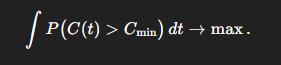
8.3 Survival invariant
The survival invariant defines the fraction of time during which the system maintains coherence above a minimal structural threshold. Maximizing this functional is a fundamental principle for EVS:
9. EVS sub-conclusion
EVS systems represent a new engineering class where internal structural unity is more important than accuracy with respect to external goals.
They function not as reactive algorithms, but as robust dynamical organisms capable of surviving chaos without destruction.
Unlike classical controllers, EVS integrate environmental entropy into their own dynamics, using it as a source of information rather than noise.
Their behavior is defined by topological stability instead of short-term error.
EVS can change trajectory shape yet preserve behavioral form — a fundamentally new level of adaptation.
Under extreme conditions EVS enter structured degradation modes, analogous to biological shutdown, preserving identity.
EVS maximize not accuracy, but the probability that the system remains coherent over long horizons.
This forms a new engineering metric — vitality, which replaces traditional stability criteria.
This approach lays the foundation for autonomous robots that genuinely withstand uncertainty rather than merely operate within it.
EVS become the first engineering paradigm where an artificial system has not only functionality, but also engineered vitality.
Final conclusion of the paper
The four experimental series show that ΔE-like models exhibit a qualitatively different type of robustness compared to traditional controllers.
Despite lower short-term accuracy, these systems possess a fundamental property — the ability to preserve internal structure under radical entropy.
This behavior cannot be described by classical optimization, error regulation, or standard adaptive control methods.
It demands a new theoretical framework, which we introduce as Engineered Vitality Systems (EVS).
EVS shift the focus from error minimization to vitality maximization.
Their objective is not strict following of external signals, but maintaining internal semantic dynamics while the environment collapses.
ΔE-like models have demonstrated robustness, topological integrity, and structural self-preservation in conditions where PID and similar methods completely failed.
This result opens the door to autonomous systems capable of functioning in environments that are inherently unpredictable and irregular.
Thus, the ΔE-like architecture not only expands the possibilities of adaptive control, but also forms a new engineering domain.
EVS become a tool for building machines that not only act, but survive.