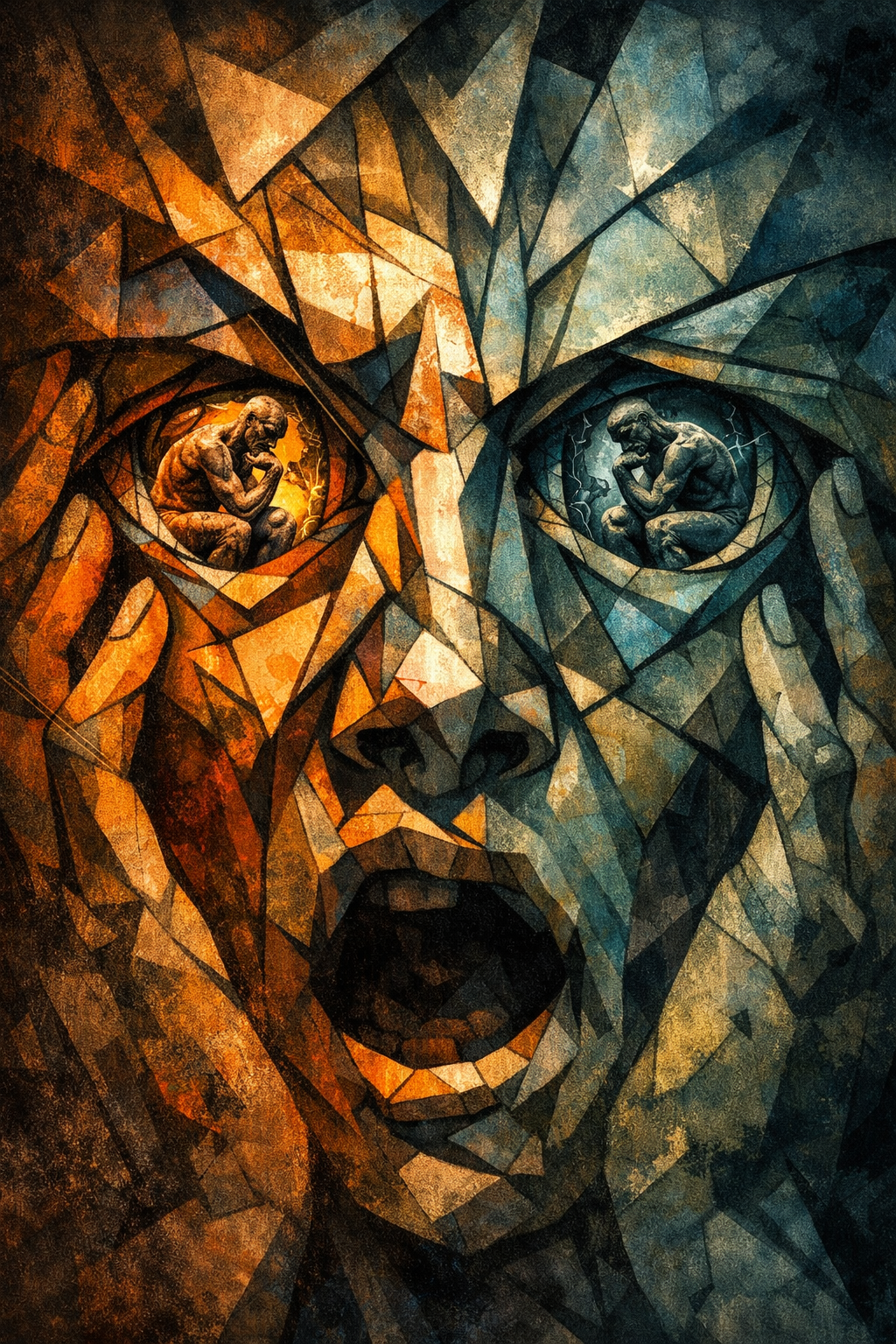
Extremes as a Test of Regimes, Identity, and Navigational Cybernetics of Order 2.5
The question “would you eat another human being in an extreme situation?” is usually perceived as a moral provocation. But in its structure, it is not a test of ethics. It is a test of naïveté. It assumes that the person answering today and the one who will exist after weeks of exhaustion, pressure, and deprivation are the same agent, with the same system of evaluations, the same time horizon, and the same structure of identity.
This assumption is false.
The answer “no”, spoken in safety, satiety, and social stability, is not a lie and not hypocrisy. It is a correct answer within the current mode of existence. It accurately describes the boundaries of what is admissible here and now. But it is fundamentally weak as a forecast, because extremity changes not the arguments, but the very system in which arguments have meaning.
An extreme situation does not add new data to the previous model. It destroys the model.
If we look at a human not as a carrier of “values”, but as a biosystem existing in time, it becomes clear that behavior in extremis is not assembled as a choice, but as a trajectory. A person does not press a button labeled “cross the line” or “do not cross”. They pass through a sequence of regimes, each of which is a holistic configuration of body, time, admissible actions, and meanings.
At early stages, social and moral identity are preserved. Then they begin to crack. Anger, fear, denial, despair arise — not as emotions, but as indicators that the previous regime is no longer coherent with reality. When the discrepancy between environment and experiential structure becomes critical, the regime collapses.
The key point here is that information is relevant only within a regime. Values, promises, reasoning, even one’s own memories are operational only as long as correspondence between internal structure and external conditions is preserved. When a regime changes, information does not merely “lose persuasiveness”. It loses applicability.
This is why the sequence of decisions in extremis is not recursive. There is no single subject who “revisits” the question again and again while updating input data. With each transition, the subject itself changes: its time horizon, priority system, admissibilities, and even the language through which it can describe what is happening.
Recursion requires a stable “self”. Extremity makes the “self” a state variable.
When deprivation reaches a level at which the body begins to fail, what activates is not “immorality” and not a “dark side of personality”. What activates is the basic ontological invariant of the living — the primacy of survival. This is not a desire to live and not fear of death. It is a structural requirement not to allow the destruction of the very possibility of continuation of the system.
At this point, identity does not degrade and does not “corrupt”. It is reset. More precisely, the system is forced to abandon the form of identity that is no longer compatible with environmental conditions and to restore itself to a minimal configuration capable of sustaining viability — conditionally, to “factory settings”.
This is where the painful philosophical question arises: who performs the action that was previously considered impossible?
Intuition pushes us toward one of two answers: either it is “the same person, but broken”, or “already someone else”. Both answers are inaccurate. Biologically and externally, it is the same human being. But the line of psychological and value identity is ruptured. The decision is produced by a configuration of the system that is no longer continuously connected to the former “self”.
This does not automatically remove responsibility. But it explains why moral declarations made “before” do not govern behavior “after”. They belong to different regimes of existence.
From the outside, such a trajectory may appear logical for subjectivity — the person always finds internal explanations for their actions. But it is not logical for identity, if identity is treated as a continuous entity. And this contradiction is not a thinking error, but a property of living systems under pressure.
This point is carried consistently throughout the entire ONTOΣ series: to understand higher forms of behavior, one must not look forward, toward improvement, progress, or ideals. One must look downward — into the ontology of the biosystem. Into the invariants that begin to operate when all superstructures cease to be operational.
In this sense, extreme cannibalism is not a topic about taboo and not a topic about sensation. It is a boundary marker. A point at which it becomes visible where the subject ends and the system begins. Where will ceases to be a choice between options and becomes navigation within what is admissible.
Navigational Cybernetics of order 2.5 is concerned precisely with this. Not with how to guarantee “correct” behavior, but with how systems maintain directionality over time when regimes are irreversible, identity is expendable, and the environment systematically destroys previous forms of stability.
From this follows a hard and uncomfortable conclusion. Ethical and volitional constructs, if they are not embedded in advance as architectural constraints, do not survive entry into extreme regimes. Their place is taken by the primacy of survival — not as evil, but as the last functioning invariant.
The essence of navigation in cybernetics of order 2.5 is not to swear “never”. It is to architecturally prevent entry into regimes in which “never” ceases to be operational. This is work with ontology, not with moral rhetoric.
The extreme does not reveal the “true nature of man”. It exposes the boundaries of the regimes within which a human can remain human.
MxBv, 2026