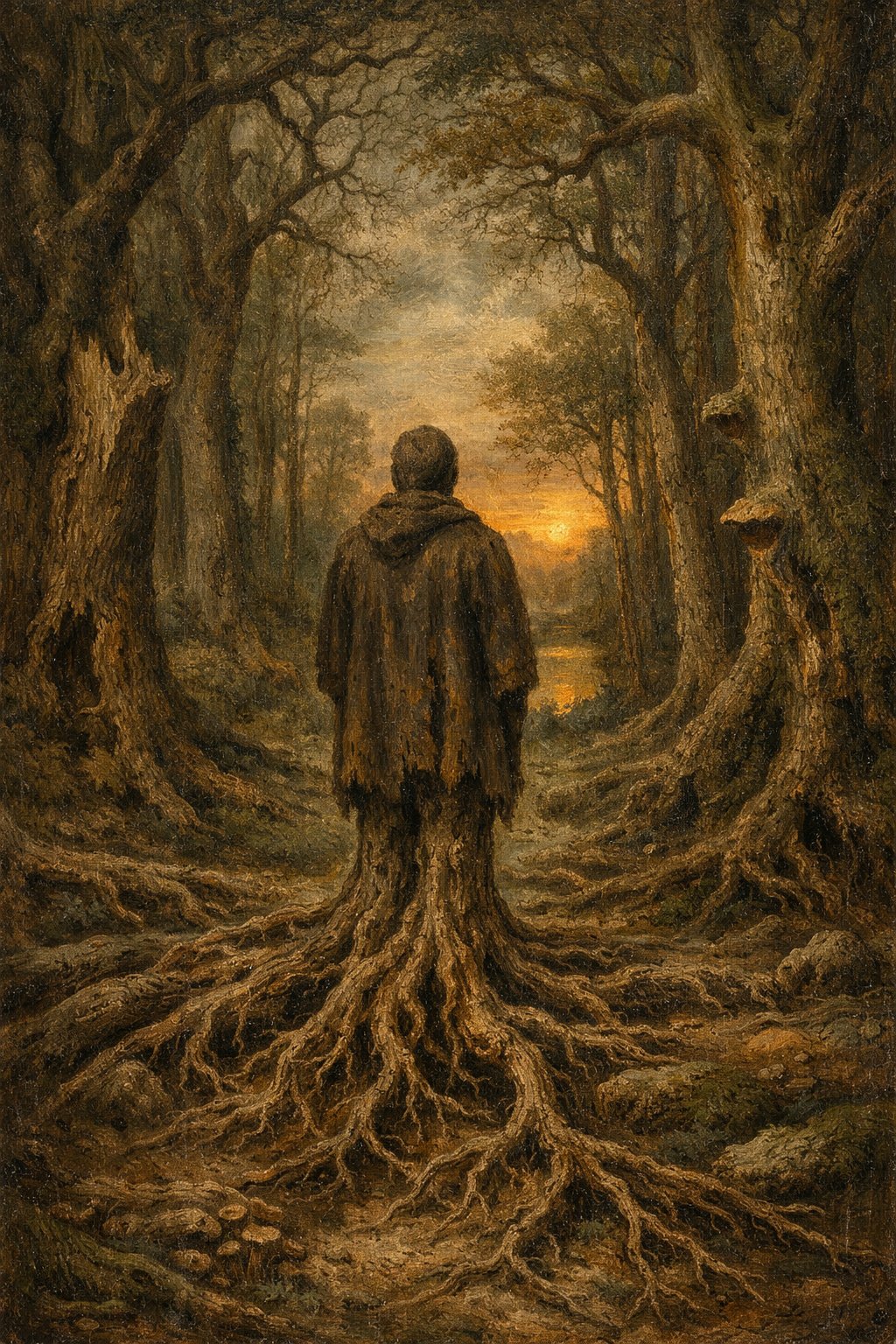
There is another asymmetry we rarely question.
Humans can change their minds in seconds. Plants cannot.
A person can wake up in one state, receive a message, and within moments decide to leave, to argue, to buy, to confess, to quit. Reaction is immediate. Direction shifts quickly. The internal landscape rearranges in real time.
A plant does not do this.
It does not "decide" to grow left and then abruptly switch right because of a passing stimulus. Its responses unfold slowly — sometimes invisibly — through gradients, accumulation, subtle orientation to light, gravity, water. There is no sudden pivot. Only gradual redirection.
We assume speed is superiority.
But speed is not free.
Rapid reaction carries a hidden cost: fragmentation. When direction can change instantly, continuity weakens. Each impulse competes with the previous one. Each new signal has the power to overwrite trajectory. A system capable of immediate redirection is also a system vulnerable to constant disturbance.
Plants evolved under different constraints.
They cannot run. They cannot reposition quickly. Their survival strategy depends on stability of growth direction. Their "decisions" are not made in the moment. They are integrated over time. Signal becomes response only after accumulation. Noise must persist before it reshapes form.
This slowness is not weakness. It is filtering.
A plant does not react to every fluctuation. It reacts to patterns.
Humans, by contrast, live in an environment of hyper-stimulation. Signals arrive constantly. Social cues, notifications, fears, desires, expectations. Each stimulus offers a new possible direction. And because the human mind is capable of immediate reconfiguration, it often complies.
This flexibility feels like freedom.
But flexibility without filtering becomes reactivity.
The ability to pivot quickly is useful in danger. It is adaptive in acute threat. Yet when the entire environment becomes a stream of micro-signals, rapid responsiveness turns into chronic oscillation.
The trajectory dissolves into episodes.
Here lies the uncomfortable comparison.
A plant may appear passive, but its growth is coherent. It does not debate every photon. It integrates light over time. It does not chase each shadow. It bends gradually, committing only when a gradient proves stable.
The human nervous system can operate similarly — but rarely does.
Beneath the instant reaction lies a deeper layer of response. A slower intelligence. One that does not answer every message immediately. One that does not alter course because of transient emotion. One that waits — not out of hesitation, but out of structural preservation.
To wait is not to freeze. To wait is to integrate.
When a human reacts immediately to every internal fluctuation, identity becomes porous. The ego reorganizes around the loudest signal. Yesterday's conviction is replaced by today's mood. The external world writes the internal script.
But when reaction is slowed — deliberately — something changes.
Not suppression. Not apathy. Integration.
You allow the signal to persist before granting it authority.
You do not silence impulse. You observe whether it remains.
This is botanical intelligence inside a mammalian system.
It does not mean becoming like a plant. It means recognizing that rapid reaction is only one layer of adaptation. Beneath it lies a slower layer — ancient, pre-verbal, pre-social — designed for long horizons rather than immediate validation.
Plants cannot change their minds in seconds. Humans can.
The question is not whether we are capable of speed.
The question is whether we are capable of restraint.
Because speed accumulates micro-fractures. Each abrupt shift leaves a subtle residue. Promises made and broken. Directions started and abandoned. Commitments reinterpreted. Over time, these fractures form internal noise. And this noise does not dissipate. It only accumulates. A broken promise is not erased by the next one. An abandoned direction leaves a mark on how you perceive every decision that follows. The load is monotone — it only grows.
Slowness, in contrast, accumulates coherence.
When a direction is chosen after integration, it holds.
There is a different quality of movement when change emerges from depth rather than impulse. It does not feel dramatic. It feels inevitable.
Modern life rewards immediacy. Instant reply. Instant decision. Instant opinion. The person who responds fastest appears most alive.
Yet life measured only by reaction speed becomes shallow.
A long horizon requires a different tempo.
Plants evolved without the luxury of escape. They built patience into their architecture. Humans evolved mobility and immediacy — but also the capacity to override them.
The real maturity of attention is not constant focus.
It is tempo control.
To be able to react when necessary. To be able to wait when necessary.
To know the difference.
This is not about becoming less human. It is about using the full range of the human system — not only the reflexive surface.
Speed is power. But continuity is survival.
A life driven only by rapid shifts may feel intense. A life integrated slowly becomes durable.
Perhaps the deepest adaptation is not the ability to change direction instantly — but the ability to let direction emerge gradually, as if you were growing toward light you have verified, not chasing every flicker.
The question is not whether you can change your mind in seconds.
The question is whether you must.
A plant turned toward the east does not doubt. It did not decide. It waited — and the light proved it right.
"Look to my coming at first light on the fifth day. At dawn, look to the East."
Some things arrive not because you chased them — but because you held still long enough to be found.
MxBv — Poznan, 2026